The Blue-Bezel PET
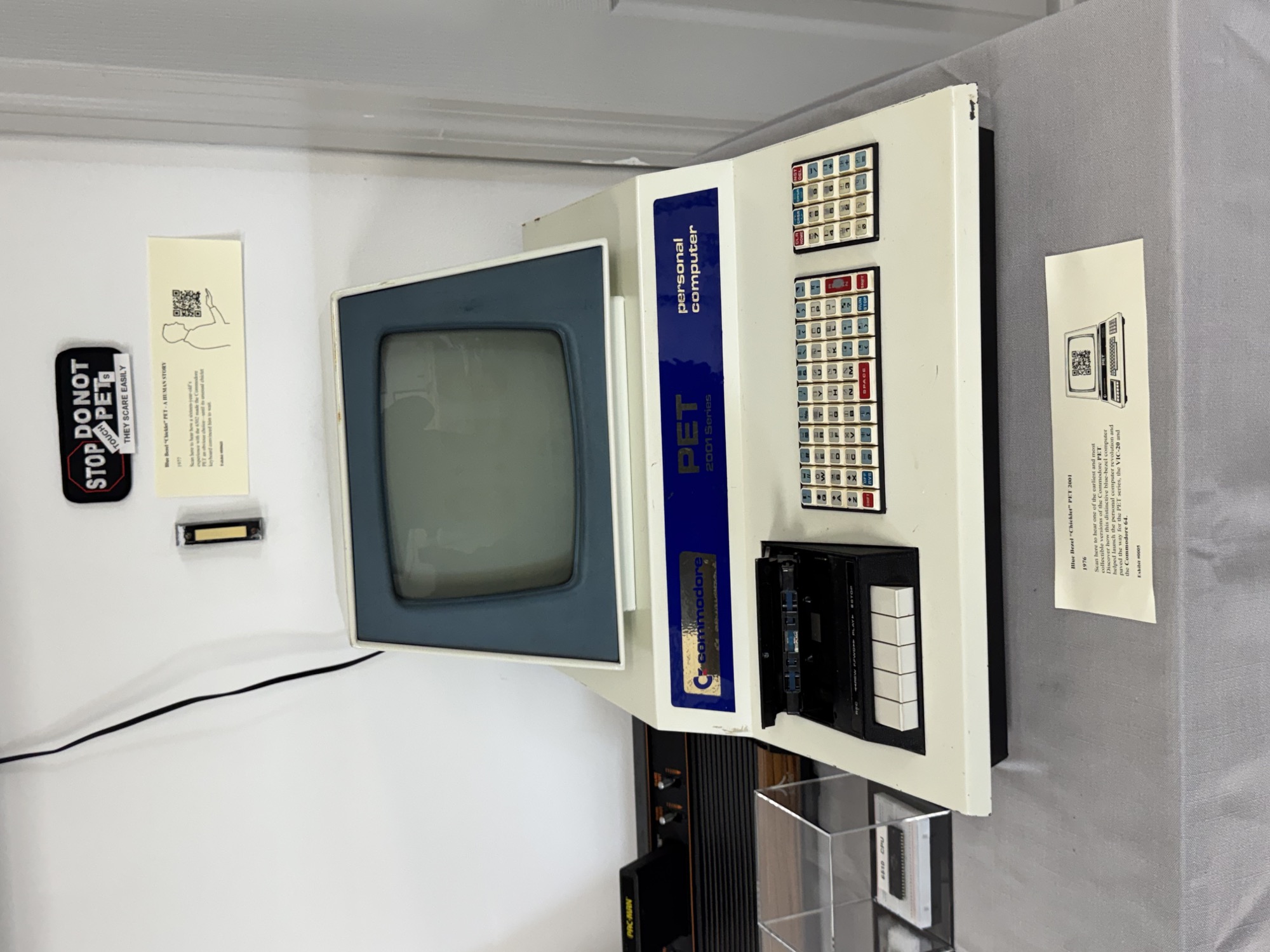
The early chiclet-keyboard PET: a complete computer in one enclosure.
In this section
- Blue-bezel PET 2001
- Built-in cassette recorder and chiclet keyboard
Hardware and History
The Human Story
Blue-Bezel Chiclet PET — A Human Story
Read: When Two Stories Began to Converge
The Commodore PET — When Two Stories Began to Converge
This is one of the most important computers in this museum: an early Commodore PET 2001, recognizable by its blue bezel, built-in cassette drive, and small calculator-style keyboard.
But for me, the story of this machine actually begins before Commodore was a computer company.
And it begins with calculators.
During the 1970s, Commodore Business Machines was heavily involved in electronic calculators. In fact, some Commodore calculators used integrated circuits supplied by Texas Instruments—the same company whose calculators I was using as a student. Commodore had expanded from typewriters and adding machines into electronic calculators, relying on semiconductor suppliers for the chips inside them.
The problem was that Texas Instruments wasn't merely supplying calculator chips.
TI was also building and selling its own calculators.
That put companies like Commodore in a very difficult position. Their semiconductor supplier could manufacture the critical components and then compete directly against them in the finished-calculator market. As calculator prices collapsed during the fierce competition of the mid-1970s, Commodore needed greater control over the technology inside its products.
That brings us to MOS Technology.
MOS had originally been involved in calculator chips itself, but in 1975 a team led by Chuck Peddle introduced something far more significant: the 6502 microprocessor.
It sold for only about $25 when competing processors could cost close to $200. That inexpensive little processor would become one of the foundations of the personal-computer revolution.
In 1976, Commodore acquired MOS Technology. Suddenly Commodore didn't simply manufacture calculators—it owned a semiconductor company and, with it, the technology and engineering talent behind the 6502.
And here's where this story becomes very personal for me.
At this point in my life, I had never heard of Commodore.
I was using my Texas Instruments calculator, interested in electronics and engineering, and following my own path.
Meanwhile, Commodore was using some of the same Texas Instruments technology that was sitting inside the calculator I was using.
Neither of us knew that our paths were going to cross.
And then another thread appeared.
MOS Technology had developed the KIM-1, a small 6502-based computer intended in part to introduce engineers and experimenters to the new processor.
In 1977, I received a KIM-1 and began programming that 6502 directly in hexadecimal machine language.
To me, MOS Technology and the KIM-1 were my introduction to microprocessors.
What I didn't yet appreciate was that Commodore had just acquired the company that made it.
So while I was learning the 6502 on my KIM-1, Commodore now owned the technology—and was preparing to build a computer around essentially the same processor. Yet, I was still blissfully unaware of Commodore.
And the result is sitting here.
The Commodore PET, introduced in 1977, used a MOS Technology 6502 running at approximately one megahertz. It came fully assembled with a monitor, keyboard, cassette storage and BASIC built into the machine.
That was significant because 1977 became one of the defining years in personal-computer history.
Three machines in particular—the Apple II, the Radio Shack TRS-80, and the Commodore PET—are often grouped together as the 1977 Trinity. Unlike many earlier hobbyist computers, these machines helped move personal computing toward complete systems that ordinary customers could purchase and use.
And there's a wonderful remnant of Commodore's calculator heritage right here.
Look at the keyboard.
Those tiny square keys are often called a chiclet keyboard, and its calculator-like appearance makes this early PET visually different from the computers that would follow.
The Computer History Museum describes the original PET as having this calculator-style keyboard, along with either four or eight kilobytes of memory and its built-in cassette drive.
What fascinates me today is the irony of what was happening in 1977.
On one path was Commodore—a calculator company being pushed toward a completely different future, acquiring MOS Technology and entering the personal-computer business.
On another path was a teenager named Ken Kranz, who had never heard of Commodore, but was already using a Texas Instruments calculator and learning machine language on a MOS Technology KIM-1.
The connection between those two paths was already there.
I simply couldn't see it yet.
The calculator company I didn't know existed had acquired the semiconductor company whose computer was teaching me how computers actually worked.
And Commodore was now building its first personal computer around the same 6502 architecture I was learning.
Those two threads were on a collision course.
Within a short time, I would discover Commodore, and the PET would become part of my own computing story. At this stage in my life, and I don’t recall the exact year, I had expanded my universe from reading science fiction novels to getting a subscription to Scientific American and purchasing computer magazines. It is through this avenue that I became aware of Commodore. I vaguely recall reading that feedback was negative toward the chicklet keyboard of the Commodore. I was somewhat interested in the Radio Shack TRS-80 and the Sinclare, but that’s a story yet to be told…
Looking back almost fifty years later, while I never owned a chicklet PET, that's what makes this particular machine so meaningful to me.
It doesn't merely represent Commodore's transition from calculators to computers.
It represents the moment when Commodore's history and my own history were approaching one another—just before they finally intersected.