From Typewriters to Calculators
Commodore’s office-machine beginnings, alongside Ken’s engineering calculators.
In this section
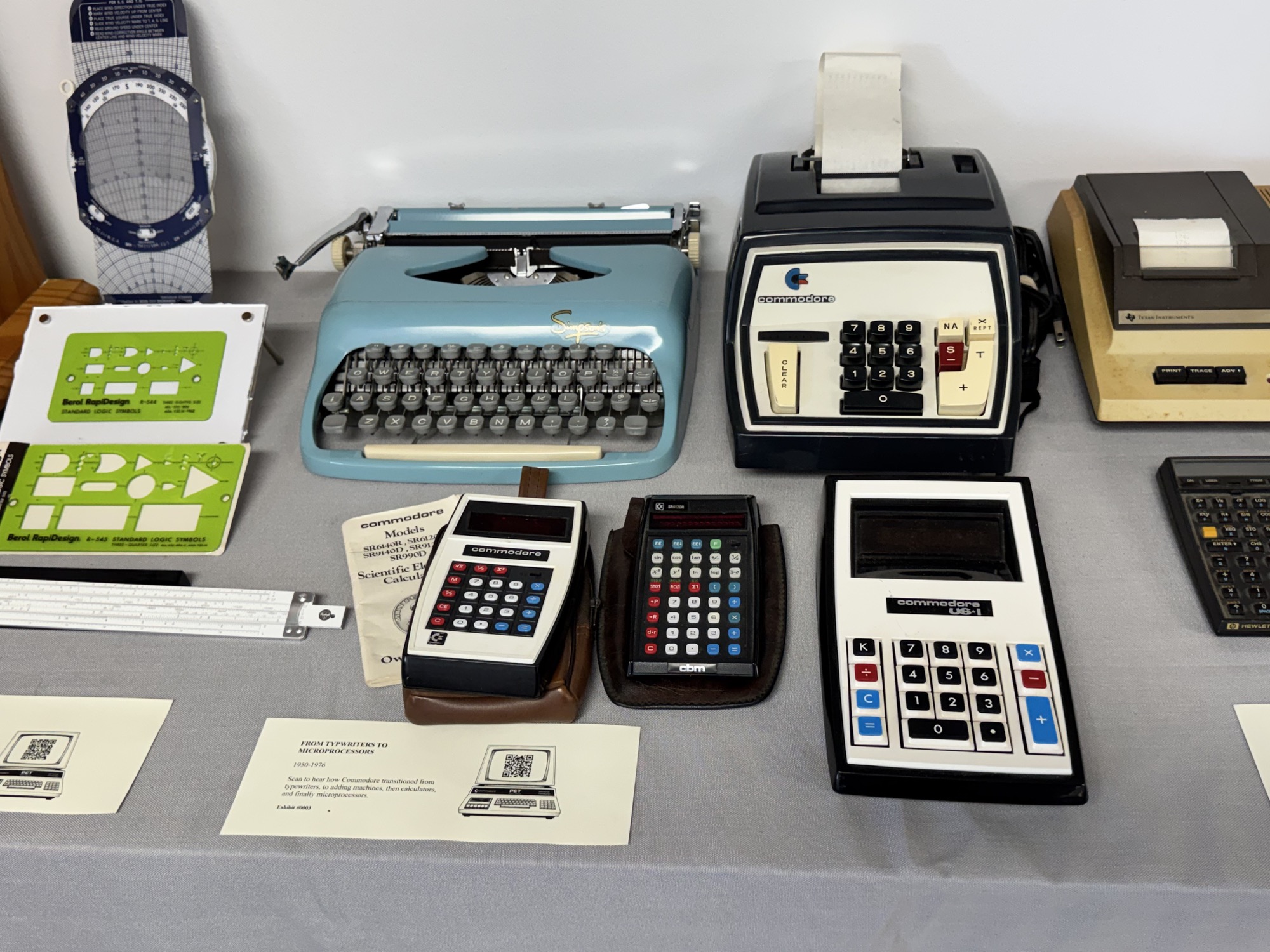
- Commodore typewriter and adding machine
- Commodore electronic calculators
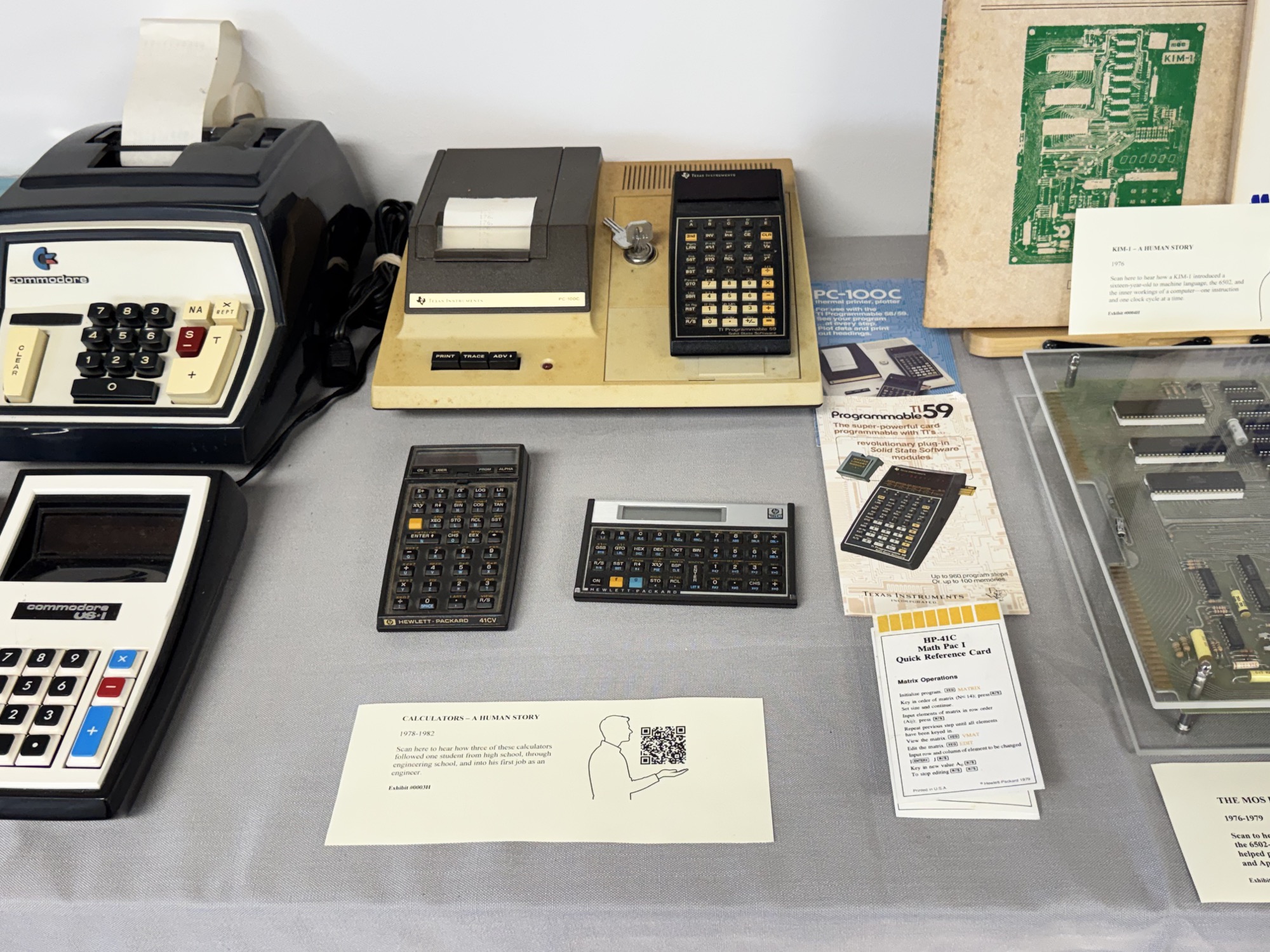
- TI-59 and printer cradle
- HP-41CV and HP-16C
Hardware and History
Read: From Typewriters to Microprocessors
From Typewriters to Microprocessors — The Calculator Revolution When most people hear the name Commodore, they think of computers.
The PET.
The VIC-20.
The Commodore 64.
Perhaps the Amiga.
But Commodore didn't begin as a computer company.
In fact, if we go back far enough, we find something that might seem rather strange sitting in a computer museum.
A typewriter.
Jack Tramiel established the business that would eventually become Commodore Business Machines in the 1950s.
Its early business centered around typewriters, adding machines, and other office equipment.
These were mechanical and electromechanical machines—not computers and, for the most part, not even electronic devices.
But this typewriter represents an important starting point in our story.
It put Commodore into the business of selling machines that people used to create, organize, and process information.
And over the next two decades, the technology inside those machines was about to change dramatically.
Sitting beside the typewriter is another step in that progression: a Commodore adding machine.
Before electronic calculators became commonplace, machines like this performed everyday business arithmetic mechanically or electromechanically.
Push the keys, operate the machine, and an intricate collection of mechanical components performed the calculation.
It's an interesting contrast with the slide rule shown on the table.
The slide rule helped a person perform a calculation.
Machines like this actually performed the arithmetic for you.
But an enormous technological change was underway.
By the late 1960s and early 1970s, solid-state electronics were transforming calculating machines.
The vacuum tubes we've already seen in this museum had largely given way to transistors.
Individual transistors were increasingly being combined into integrated circuits, allowing more and more electronic functions to be placed onto a small number of chips.
Mechanical calculation was giving way to electronic calculation.
And Commodore moved aggressively into this new market.
At the beginning of the 1970s, an electronic calculator could still be an expensive and impressive piece of technology.
But semiconductor technology was advancing extraordinarily quickly.
Calculators became smaller.
Faster.
More capable.
And perhaps most importantly.……
cheaper.
For a time, calculators became an important and successful business for Commodore.
But there was a fundamental weakness in Commodore's position.
Commodore didn't control the technology inside them.
The critical components inside electronic calculators were semiconductor chips.
And one of the companies supplying those chips was Texas Instruments.
But Texas Instruments had an enormous advantage.
It didn't have to limit itself to selling calculator chips to companies like Commodore.
Texas Instruments could manufacture calculators too.
That meant a semiconductor supplier could manufacture the critical components, put those same technologies into its own calculators, and then compete directly against the companies buying its chips. It didn’t hurt that they could also jack up the prices to companies like Commodore while, at the same time, competing directly against them.
As calculator prices fell rapidly during the 1970s, that became a serious problem.
The calculator business descended into a brutal price war.
And Commodore found itself increasingly squeezed. And, if it was any consolation, TI eventually found themselves squeezed by the onslaught of Japanese calculators into the American market. For Jack Tramiel there was an important lesson in all of this: If another company controls the critical technology inside your product.……
Then that company can influence your future.
Tramiel wanted greater control over the components Commodore needed.
And that brings us to one of the most consequential decisions in Commodore's history.
In 1976, Commodore acquired MOS Technology, a semiconductor manufacturer.
At first glance, acquiring a semiconductor company made perfect sense for a company trying to gain greater control over the electronic components in its products.
But Commodore was about to get much more than a source of calculator chips.
Because MOS Technology had been working on something else.
A remarkably inexpensive microprocessor called the.……
6502.
We'll come back to that shortly.
But while Commodore was being pushed away from calculators and toward an entirely different future, the calculator wasn't going away.
Quite the opposite.
It was evolving.
And these next three calculators illustrate just how rapidly that was happening.
Unlike most of the artifacts we've looked at so far, these three calculators were personally owned and used by Ken Kranz, founder of the Long Island Vintage Computer Museum.
The first is the Texas Instruments TI-59.
Introduced in 1977, the TI-59 was far removed from the simple four-function calculators that had flooded the market only a few years earlier.
It was programmable.
Programs could be stored on small magnetic cards and loaded back into the calculator when needed.
And this printer cradle allowed programs, calculations and results to be printed on paper.
A device that fit in your hand was beginning to acquire some of the characteristics we normally associate with a computer.
Then came machines such as the Hewlett-Packard HP-41 series.
This HP-41CV was purchased in 1980.
It was programmable expandable, and designed for serious scientific and engineering work.
It also used Hewlett-Packard's Reverse Polish Notation, or RPN, which required a different way of entering calculations than the algebraic notation used by most calculators.
These weren't simply devices for replacing pencil-and-paper arithmetic anymore.
They were becoming sophisticated tools for solving complex technical problems.
The fact that the HP-41CV had options for a math and statistics pack (some of Ken’s favorite subjects) on the back and also an Aviation pack (he started flying lessons when he was 16) was one of the main reasons he abandoned the TI-59 and made the switch to HP.
And then, in 1982, came The HP-16C calculator.
The name itself tells us how far calculators had evolved. Side note: Ken bought this the moment it debuted because he had secured an engineering job in his second year of college programming applied math based radar processing formulas in Data General assembly language at the Airborne Instruments Lab (AIL). A job working with radar data dovetailed nicely with his budding flying ambitions. Commodore was pivotal to obtaining this position and that story will be covered in more detail later. This calculator wasn't designed for accountants or even traditional scientific calculation.
It was designed specifically for computer programmers – specifically for computer programmers working at a very low level – close to the machine hardware itself.
It could work directly in decimal, hexadecimal, octal and binary.
It could perform logical operations and manipulate individual bits.
It allowed programmers to work with numbers in much the same way that the processor inside a computer did.
By this point, the distinction between a sophisticated programmable calculator and a very small, specialized computer was becoming increasingly interesting.
And this raises an interesting historical question.
While Texas Instruments and Hewlett-Packard continued developing increasingly sophisticated scientific, engineering and programmable calculators, Commodore was leaving that business behind.
Had Commodore remained primarily a calculator company, could it have successfully competed in this increasingly specialized market?
We don't know.
History took Commodore in another direction.
And ironically, the very competitive pressures that helped drive Commodore away from calculators also helped give the company something far more important to its future: MOS Technology.
And the 6502 microprocessor.
The 6502 represented another enormous change.
Instead of designing a machine around circuitry dedicated to performing a particular set of calculations, manufacturers could increasingly build products around a general-purpose programmable processor.
Change the program.……
and you could change what the machine did.
And sitting just ahead of us is one of the earliest machines designed to let people explore exactly what that meant.
The MOS Technology KIM-1.
The KIM-1 was introduced in 1976—the same year Commodore acquired MOS Technology.
It was built around the 6502.
And unlike the polished calculators we've just seen, the KIM-1 stripped computing almost down to its essentials.
A circuit board.
A processor.
Memory.
A hexadecimal keypad.
A six-digit display.
And documentation that taught you how to make it all work.
We'll explore that machine in the next exhibit.
So this collection represents much more than a typewriter and a group of old calculators.
It captures an extraordinary technological transition.
Mechanical and electromechanical machines gave way to solid-state electronics.
Transistors gave way to increasingly sophisticated integrated circuits.
Simple electronic calculators evolved into programmable scientific and engineering machines.
And semiconductor technology eventually made it possible to put the central processing unit of a computer onto a single chip.
For Commodore, the calculator price war represented the end of one era and the beginning of another.
The company that had sold typewriters, adding machines and calculators acquired the technology—and the people—that would allow it to build something entirely different.
Computers.
And that's where we're going next.
The MOS Technology KIM-1.